Tuesday, May 30, 2017

Adventures with Angela: Saint Louis


We left the desert after lunch and headed up to Saint Louis. I don’t know why I thought it would be a good idea to do that trip at the hottest time of the day, but it wasn’t the best idea. I also didn’t plan this particular leg of the trip ahead of time, thinking the people at the lodge in the desert would be used to making those kinds of arrangements. When I asked one of the guys at the lodge if they had a contact for someone who could take us up to Saint Louis, he said he did and arranged it for us. Little did we know that it would be a beat up, windshield broken, no inside door handles, air-conditionless taxi. It was over 100 degrees out for pretty much the entire trip, but we had the windows partly down and enough water, so it wasn’t a big deal. The only thing I was a little worried about was breaking down in the middle of nowhere when it was so hot out, but that didn’t happen!
There wasn’t much to see along the way, since we didn’t go through any major towns, just a few small villages. We saw a lot of baobabs, huts, horses, donkeys, cows, and goats. When we got out of the villages and were on pretty desolate stretches of road I saw a good amount of animal carcasses, finally just ended up paying a bit more attention to see if we’d pass at least one carcass of every farm animal (we did). It was something to do to pass the time.

When we got to Saint Louis the temperature dropped significantly because we were on the coast in the northernmost part of the country. We were dropped off at our hotel, which ended up being at the very far end of the Langue de Barbarie (a 600km stretch of sand that separates the Senegal River from the Atlantic Ocean) that makes up a part of Saint Louis… That’s the problem with booking a hotel room without knowing the town! Oh well, it was a very nice resort, and very quiet because it was so far out! The first thing I did when I got to our room was take a hot shower. It’s one of the things I dearly miss since my apartment has no hot running water. Then we grabbed a cab to go into downtown and take a tour of the historical part of town in a horse drawn cart.

Our guide, Élage, was a younger man who told us all about Saint Louis as he deftly drove MC Solaar (the horse named after the famous French hip hop/rap artist) through the crowded streets. Saint Louis was the original capital of French West Africa, and the major urban center for sub-Saharan Africa by the late 18th century. The original town (and where we were touring) is actually a small island (only 2 kilometers long and 400 meters wide) in the Senegal River (but only 25 meters from where it hits the Atlantic), with the Langue de Barbarie to the West, shielding it from the Atlantic Ocean. It was uninhabited when some French traders decided to establish the first permanent French settlement there in 1659, calling it Saint-Louis-du-Fort after the French king Louis IX (who had recently been canonized) and their current king, Louis XIV. The capital of the French West African Federation was moved from Saint Louis to Dakar in 1902, but Saint Louis was still officially the capital of the Colony of Senegal (and neighboring Colony of Mauritania). When Senegal gained its independence in 1960, Saint Louis lost that status as well since Dakar was kept as the capital.  When it was no longer the capital, nor the main trading hub, it declined rapidly.


Now the historic center is a UNESCO World Heritage Site and tourism is a big part of their economy. Fishing also plays a big role, so even though it was almost dark, Élage drove us over the bridge that connects the island of Saint Louis with the Lange de Barbarie where the fisherman’s village is located. It was a bit crazy, with a ton of people, cars, horses, and sheep/goats everywhere. Élage told us that the Fisherman’s Village had some of the wealthiest homes in Saint Louis. Since it didn’t outwardly look like it, he had to explain to us how he knew that: First of all, many of the building had multiple TV antennas on them, which meant that family had multiple TVs. He also told us that meant there were multiple wives in that house. Why does that mean there are multiple wives? Élage says its because each of the wives are too jealous to even share a TV… He was a bit of a jokester, especially on the subject of women/wives, so am not entirely sure if that’s reality or not. Secondly, there were a ton of goats and sheep. Élage explained to us that since people did not have the most confidence in banks, they kept their fortune in sheep. If something happened and they needed to “withdraw” a large sum of money, they would sell a sheep or goat. Interesting banking system… and I’m not sure it’s any less reliable than our system, and their money can birth more money!

Another interesting aspect of the old colonial part of the town is the separation of the Catholic and Muslim parts of the island. Like I said, the island was uninhabited when the French settled there, so it was predominantly Catholic until the mid-19th century. With the rise of the Muslim population came the attempt to separate the two populations in order to keep the peace. There was actually a wall that cut across the width of the island separating the two communities.
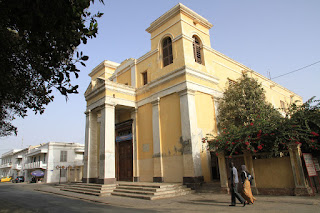
The Catholics lived in the southern half of the island while the Muslims lived in the northern half. The cathedral was started in 1827 and finished in 1830, while the large mosque was started the same year, but finished a year earlier. The cathedral in Saint Louis is the oldest Catholic Church in West Africa, which makes sense since it was the capital of the French West African Federation.   

By the end of our tour it was about 8pm and quite dark out, and since we had had a snack before we left the hotel, we weren’t looking for a large meal. I’d heard that there was an awesome crêperie in the area, so we sought it out and shared one amazing dinner crêpe, but ordered separate dessert crêpes (priorities!!). Once we finished, we grabbed a taxi to get back to our hotel, but the taxi driver lied and said he knew where our hotel was and then drove us the wrong direction. That meant that, despite my objections, he took the one and only bridge off of the island of Saint Louis onto the mainland, which was the opposite direction he needed to go because our hotel was out on the island that separates the river from the Atlantic. Once he got over the bridge I told him to turn around and go back, but instead of turning around, he just turned and started to go down a not so well lit side road that was a little creepy. At that point I had a tinge of apprehension thinking he had other plans than to take us back to our hotel, so I got angry and told him if he didn’t turn around and go back we were going to get out and get another taxi. He turned around and went back the way we came (phew!) and I was able to direct him to our hotel, where we crashed quickly in our anticipation of a 6:30am alarm. We had arranged with a guide to pick us up at 7:30am for a tour of the famous bird park, which is the subject of my next blog!

Thursday, May 25, 2017

Adventures with Angela: Lompoul Desert


Monday was a complete splurge and the most expensive part of the trip: On the recommendation of a colleague, I found a tour company that would take us to Lac Rose, AKA Pink Lake or Lake Retba, and then to the Lompoul Desert where we had a tent reserved for the night! The reason why it was so expensive was because instead of driving on the inland roads from Lac Rose to Lompoul, we drove along the beach, just out of the water.


We had to hang around Lac Rose until about 3:30pm to wait for the tide to go down enough for us to be able to drive along the coast. Leaving Lac Rose, we went directly to the coast and started driving on the beach. The part we were driving up was pretty deserted, mostly because of the time of day and of how hot it was. Our driver Moustapha told us that it would be a lot more crowded in about 2 hours when the temperature went down and people got finished with work. That part of the coast had the perfect, multi-layered surf that you see in the movies, so it was a beautiful drive just watching the surf. Apparently driving up the beach is very strategic because you can’t drive on the deep, dry sand because it’s just too hard, but you can’t drive on too wet of sand, so the perfect spot is where the high tide was recently. Moustapha said it was like driving in the snow and we were constantly dodging the incoming surf, staying just outside the water’s reach. At one point we almost tipped over because he tried to avoid the surf and an eagle at the same time, losing control and sliding, which was very exciting. He apologized for scaring us, but we told him that both Angela and I have ridden in cars driven by our brothers, so it was no big deal, ha ha!


Eventually we got to one of the major fishing villages on the coast, which forced us to get out and walk because there were people and boats everywhere, so a car can’t get through. Moustapha told us to get out to walk and that he’d meet us on the other side of the fishing village. It was very crowded and there were a ton of huge, colorful pirogues for fishing. We met Moustapha on the other side and kept going up the beach, until he stopped and said something was wrong with the car. We found out that the cable for the accelerator had snapped. We told Moustapha we didn’t mind just walking up the mostly empty beach while he made the repairs, so Angela and I continued on foot, enjoying walking in the sunshine watching the surf. It only took him about 30 minutes to fix the cable and then he picked us up to continue our journey up the beach. Another 30 minutes or so later we got to a spot where it wasn’t passable with the car because the tide hadn’t gone down enough. We left the beach and continued up to Lompoul on normal roads, but we had thoroughly enjoyed our trip up the beach.

Right as we were pulling into the Lompoul Village, which is the village near the Lompoul Desert, I got a call from the Ecolodge asking where we were and what time we’d be there. Excellent timing! The Ecolodge truck that would be used to transport us out to the desert was already there waiting for us, so we thanked Moustapha and climbed into the back of the pickup. The Lompoul Desert resembles the Sahara, with its orange sand dunes, except that it’s only 18 square kilometers. When we arrived, they showed us to our beautiful tent modeled after the tents used by the nomadic people of the desert, and told us dinner festivities started at 8pm. We decided to change into warmer clothes because we knew the temperature usually drops at night in the desert, but it was about 7pm at that time and I didn’t want to miss the sunset, so we rushed out to climb up the hill and watch the sun go down.

I had heard that the sunset amongst the dunes was amazing. Unfortunately it was pretty hazy, so it wasn’t actually very good. Once it went down, we decided to try our hand at sand sledding before the last of the light disappeared. It’s a lot harder than it seems! We tried a couple of times, but the problem is that every time you sled down, you have to climb back up the sand dunes, which is really tiring! It was getting pretty dark at that point, so we decided to try again in the morning. We also planned to go on a camel ride through the dunes in the morning, so I was looking forward to the next day.

We climbed up the dunes to where the meals are served, took a seat around the mat where the musicians perform, and ordered a glass of wine. We knew that dinner was pretty far off, since it’s supposed to start at 8pm and it was almost 8… that’s African time! But the music started and the other guests started to gather, so we enjoyed the ambiance. Then the dancers came out, trying to get people up and dancing. There was a very enthusiastic older French gentleman who started things off, then of course Angela and I joined them, along with, eventually, many of the other guests.

We did some dances where people went in and out of the middle doing solo dances, and some group dancing. Towards the end we did some more dance-off types, and Angela got into a dance-off with the older French gentleman, and then with the resident African dancer. She held her own and everyone was very impressed. I tried to use some of the Bèlè dancing I’d learned in Martinique, but it was very hard because they had put a woven mat down on top of the sand, which made it extremely hard to do that type of dancing. A good, but generic, dinner followed the dancing, and then we went to bed because I wasn’t feeling well and didn’t want to get sicker by staying up outside in the cold (even though it would have been nice to participate in the after-dinner campfire).

The next morning we got up and had breakfast before trying our hand again at sand sledding. We realized that we needed to go to the really high, steep part of the sand dunes to get going at all! We also figured out that we needed to lean back so that the front of the wooden sled didn’t go into the sand. We felt we were fairly successful, although it was nothing compared to how fast the little kids got going… I think their light weight helped them out a lot. We wanted to go on our camel ride, but they had been taken out by another group, so we lounged in the hammocks until they got back.

I’m so glad that we went on a camel ride here because I was pretty disappointed with my camel ride experience at Lac Rose on my birthday. The camel there weren’t treated super well, but the Lompoul camels were a different story. Angela and I were the only two on this ride, so I was able to ask questions our guide questions about them. Apparently these camels are bought young, and trained to be ridden by the people here in Lompoul by the age of 7 years old. They are kept for most of their life, giving rides to tourists a few times a day and generally hanging out in the shade of the trees. They were well trained (no kicking or hitting like at Lac Rose), in good health, and looked generally happy. Our short ride through the sand dunes was very cool and I’m glad we did it!

After our camel ride, we just hung out in the hammocks in the shade until lunch time, enjoying being on vacation! We had lunch, said goodbye to the desert, and headed to our next destination: Saint Louis! That’s the subject of my next blog post J

Thursday, May 11, 2017

Adventures with Angela: Lac Rose


After a somewhat quiet weekend in Dakar, on Monday we headed north out of Dakar for a few days out of the capital.
Lac Rose (Pink Lake) water
We started out about 10am and headed to Lac Rose, which is named as such because of its naturally occurring color. Lac Rose is one of the saltiest lakes in the world, with the salt content almost twice that of the Red Sea. There’s only one other lake in the world like it and it’s in Australia. The reason it’s so salty is because it’s only separated from the Atlantic Ocean by about 1 kilometer of sand dunes. The water in the lake comes through the sand dunes from the ocean. There’s a specific algae, Dunaliella salina, that thrives in salt water and has a red pigment to it when it’s absorbing light. In order for it to be really pink it needs, sunshine, a bit of wind (to move the water around so the sunshine hits more of it), and of course the salt to encourage the growth of the algae.
 Our guide told us the lake was only recently (as in the early-mid 1900s) “discovered” by locals. This is because it was mostly covered with vegetation, and the people group in that area were mostly nomadic shepherds. They didn’t know about the water underneath the vegetation because it didn’t matter, their animals couldn’t drink it! It is too salty to hold any fish, so it really didn’t serve any purpose for the people groups in that area until it was discovered by a shepherd whose animals wouldn’t drink it! Eventually, they realized they could harvest salt.

The harvesting of the salt is open to anyone who wishes to do it. It is considered an “artisan” activity and therefore unregulated by the government. There are no limitations on who can come harvest, everyone is welcome. The unofficial rules are simple: no fighting, no stealing, no cheating. Each harvester has their own pile of salt that is labeled. It seems that the amount of salt in the lake is unlimited, at least for now, so there aren’t limitations on who can come. People come from all over Africa to harvest. Our guide told us that men will come harvest salt for a couple of years to save a lot of money up before returning home. I think what limits the amount of people on the lake is the amount of pirogues available for doing the harvesting, as well as men willing to do the harvesting. It’s really hard work! First, they can’t usually do it more than a few times per week (every-other day) because, even though they cover themselves with Shea Butter to protect their skin from the salt, it’s still harsh working conditions. Second, the harvesters are not the only part of the equation, it’s a 3-part system. You have the guy who owns the pirogue, the harvester, and the woman (or women) who empties the pirogue. The amount of salt that is harvested is split between the three participants.
At first I thought it was a bit much for the owner of the boat to get the same share as the two people who did the hard work of harvesting the salt from the water and then removing it from the boat, but then we learned that a pirogue can only last about 6 months on the lake because of the salt content. Pirogues are expensive, so it makes sense that if it has to be replaced twice a year, the owner would need that portion of the salt harvest.
The men who harvest use 3 things to do so: a wooden pole with a flat blade on the end of it (similar to a shovel), a basket, and the pirogue. The first thing they do is use the pole to break up the salt at their feet. Then they put the basket down and use their feet to put the salt into it before pulling it up and dumping the salt into the pirogue. The salt looks fairly disgusting as it is pulled out of the water with a blackish-gray tint to it. While it’s in the boat, the water filters out of it and it already starts getting lighter in color. Each pirogue can carry about a ton of salt. If they work well and at a steady pace, they can fill 3 pirogues a day. That means one man is breaking up and pulling out 6 thousand pounds of salt a day.
 This also means that 3 tons of salt is being removed from the pirogues by women and put in piles on the beaches of the lake. The piles of salt sit in the sun so they can dry, which makes the salt its natural white color. The women are responsible for selling the salt as well. The market for the salt is mainly to the fisherman because the Senegalese smoke/dry their fish with salt from Lac Rose. We can also buy salt at a very reasonable price from the ladies on sight, which both Angela and I did.
We learned all of this while floating around the lake in a pirogue. The lake wasn’t very pink because we didn’t have enough of all the necessary elements:
Sunshine: the air wasn’t super clear, so we didn’t have direct sunlight. This time of year the harmattan winds are kicking up
a lot of sand and dust into the air, so it was hazy that day.

A bit of wind (to move the water around so the sunshine hits more of it): If we had had wind, it wouldn’t have been as hazy…

Salt: This is an interesting part of what we learned: The Lake is rarely visibly pink anymore, at least not the way it used to be. Why is that? Because the salt is being harvested at a fairly rapid rate, so there isn’t as much of it to encourage the growth of the algae.

After our educational ride around the lake, we headed over to the area where the restaurant and beach are located, which is on the other side of the lake from where the salt piles were. We snagged some chairs and got ready to go in the lake. We couldn’t really swim in the lake because of the salt content, which just made us float.
Angela floating in the lake

And, while the salt water is good for skin, it’s not advisable to spend more than 15 minutes in the water, so we definitely didn’t put our face or hair in the water! It’s an interesting sensation to be in water with that high of a salt content, but I wouldn’t say it’s particularly comfortable. This is especially true if you have any sort of scrapes, cuts, or even if you’ve recently shaved at all. I didn’t know I had some scrapes on my leg until I went in, but it was obvious once I got in the water! I didn’t last longer than a few minutes. It also has a very particular smell to it that isn’t pleasant. Once we got out of the saltwater, we went over to the area they have set up for rinsing off because it’s not good to leave salt residue on the skin. Once we were done with the actual lake, we rested in the hammocks and had lunch, killing time before we embarked on the next leg of our adventures: a drive up the coast to the Lompoul desert, which is the subject of my next blog!
Hi from Lac Rose!

Thursday, May 4, 2017

Adventures with Angela: Ceebujen and HLM

Bonjour All!
That time I got Angela on a horse!

This is the first blog in a short series about spring break and my adventures with Angela! My friend Angela came from San Diego for an 11-day visit. Background: Angela and I have been friends since junior high school when we were in drama class together at Tierra del Sol Middle School in Lakeside (San Diego County). I moved away to Oregon when we were 15, but we’ve kept in touch over the years. She’s stayed in San Diego, except for the 4-year stint at UC Berkeley, so I was able to visit when I’d go down to see family.

Over the years we’ve had some nice adventures together. She came to visit for a couple of weeks when I was teaching in China, we’ve done road trips up and down the West Coast, she’s stayed with me at Grandma Mert’s, and Aunt Marci’s. She flew out from San Diego for my graduation from UD last May, which happened to fall on her birthday! This time she made the long trek out to West Africa for some epic adventures in this corner of the world!

We started off with pretty basic Senegalese necessities: The national dish of ceebujen at Mama Soda’s and then off to the fabrics market, HLM. We decided to eat our ceebujen (rice with fish and vegetables) in the traditional style, meaning seated on the floor around the communal food bowl, eating with our right hand (no left hand allowed makes it a bit difficult for a lefty like Angela, but she managed well).
Angela and Mama Soda
We also had homemade bissap juice (made from the hibiscus flower), which is another staple in Senegalese households. As we left, she offered us the rest of the bottle, so we decided to drop that off at the apartment before heading out to HLM market. That also gave us a chance to have some espresso as a quick pick-me-up to fight against the food coma we were in because of the ceebujen!
I have a pretty good tailor here in Dakar who does a great job fairly quickly, so I told Angela he could probably do whatever she wanted, even if he only had 10 days. HLM is famous for its selection of African Wax print fabric. This fabric has an interesting history because it isn’t actually African! It was originally made by the Dutch, who were trying to copy the traditional way the Indonesians used wax to dye their fabric. They figured out a way to replicate their method using machines, although the quality wasn’t as high. It didn’t catch on in Indonesia, but it became super popular in West Africa, so they switched their marketing to West Africa.
Hundreds of stall like this = lots of choices!!!

 It usually costs between 1,000 to 2,000 cfa a yard (that’s about $2-$4 a yard). The trick is to find someone who is willing to sell it in smaller pieces than just 6 yards. The fabric is shipped in 12-yard blocks, so some of them won’t do more than cut it in half, selling at least 6 yards. For what we want to get done, we usually only need 2-4 yards, so the first thing I ask when we enter a stall is whether or not they’re willing to cut. Because I tend to be the one who takes Mama Soda’s host students there to get their fabric, I’m getting to know the place fairly well! There are a couple of places I know have a good selection, so we walked around and looked at a bunch of stalls so Angela could get an idea of what was available, then we started the real shopping. We went to one place I particularly like because it has a really good selection and it’s already cut and sorted by 2,3, and 4-yard pieces.
Angela found 4 or 5 different fabrics she liked there, and I got a couple myself. Then we went back to another place where we’d seen some things she liked and got a couple more. On our way out we saw another fabric that was really nice, so she got that one too… she ended up with 9 different fabrics! All fairly different. We spent the evening deciding what she was going to have made with each fabric, since we had to go to the tailor the next day and get everything started.

We went to Diouma on Sunday afternoon, gave him drawings and pictures of what she wanted and he took her measurements. We went back on Thursday to try everything on so he could do the necessary alterations. Then we picked everything up, finished and awesome, on Friday! They were definitely some awesome souvenirs! I definitely need to get one of these made:

Monday, April 17, 2017

Embassy Work: RELO


Another aspect of my Fulbright is working with the Public Affairs Section (PAS) of the US Embassy and the RELO (Regional English Language Office(r)), assisting them in their efforts to support English programs and teachers in the area. So here are a few things I’ve gotten to participate in connected to the RELO:

Access: Conference in Saly (I wrote a blog about Saly already, so you can read about it here) and Graduation: The Access graduation was a nice little ceremony to honor those students who had completed the two-year Access micro-scholarship program (to learn more about this program, you can read my blog on Saly, or see the description on the State Department’s website). Safi, the RELO assistant, was the Master of Ceremonies, and the acting Chief of Missions (the person who stands in for the Ambassador when they’re absent or we don’t have one, which is the case right now) was there to speak.

Each group of students does some sort of performance and there are a few speeches given. A student representative spoke, as well as a representative of the parents. Pictures were taken of each school’s group with their certificates and Martina Boustani (the acting Chief of Missions). It was a nice little ceremony and I’m sure some of the students who graduated are future English teachers!

ATES Annual Conference: ATES is the Association of Teachers of English in Senegal (yes, it’s an awkward word order because it uses the French word order, but English words). Once a year they have a big conference for Senegalese English teachers. This year it was held in Bambey, which is a small town a few hours east of Dakar. In recent years the Fulbright ETAs have done presentations for the teachers, either at the actual conference on Saturday, or at the workshop that is offered by the RELO on Friday. For the RELO workshop Safi gave a presentation about project-based learning and then I gave a presentation on teaching academic writing.

I am certainly not an expert in academic writing, but it was a subject they had specifically requested, so I did some research and my best. The workshop was very well attended… maybe too well! We had originally expected 80 participants because usually the workshop is specifically for the English teachers of the local chapter that had the task of organizing the convention that year, but people from other areas came as well, so there were almost 200 people. The room wasn’t really meant for that many people, so we were pretty crammed in there. Unfortunately it was already quite hot out, so that didn’t help increase the comfort level, but we all made it work. The next day was the actual convention, and since I presented at the workshop, I didn’t present during the breakout sessions. None of the other ETAs presented, but the two ELFs, Lea and Liam, gave presentations, as did a few of my students, supervised by Mathiam Thiam. One thing the conference showed me was how motivated, dedicated, and interested the English teachers here are; they really seem to have a thirst for knowledge and ways to improve their teaching.
Mathiam and Myself with two of our students who presented in Bambey
ELF Conference

The English Language Fellows had a regional (sub-Saharan Africa) conference here in Dakar and Eran asked ATES if they wanted to have a workshop day with them. Of course they were very interested, and they decided to hold it at FASTEF where I teach. Not being an ELF, I was not presenting, but I was “hosting” since I am part of the English department at FASTEF. I arrived first (of course) and was able to give the ELFs a tour of the campus while things were getting set up.

Three breakout sessions were planned, with teachers being able to choose the subject that interested them the most. I ran around a bit at the beginning making sure everyone had what they needed (projectors, whiteboard markers, etc.) and was a “moderator” for one of the rooms. Because there were breakout sessions, the moderators are in charge of taking notes and recapping, briefly, the presentations to the whole conference at the end.

English Language Day (ELD)

English Language Day is a day to honor English teachers in Senegal, especially the one chosen as teacher of the year. There are presentations on teaching and information booths in order to inform English teachers of the resources available to them. ELD was held at the local university, which made it very convenient! I knew many of my students would be there and the RELO had a table. Anthony, the other Fulbright ETA in Dakar, was slotted to do a presentation and I was ‘moderating’ his presentation (meaning I introduced him and did the Q&A session afterwards). In typical Senegalese fashion, it started a couple of hours late, but I didn’t mind because it gave me a chance to catch up with Safi, the assistant RELO, who I hadn’t seen in a while.
I ended up helping her man the RELO booth for the day, which was nice. They honored the teacher of the year, as well as Ngouye Mbaye, the sweetest woman who has just retired from running the English office of the Senegalese Ministry of Education. It was a very nice tribute to her and generally a nice day among English enthusiasts.

Embassy Work: PAS


Another aspect of my Fulbright is working with the Public Affairs Section (PAS) of the US Embassy and the RELO (Regional English Language Office(r)), assisting them in their efforts to support English programs and teachers in the area. So here are a few things I’ve gotten to participate in connected to the PAS:


Language Resource Center (LRC): Every Wednesday I host a conversation club in the multi-purpose room of the US Embassy. This is for Senegalese members of the LRC, which is basically a library where they can access materials in English. Based on the theme of the month (Such as Women’s or Black History month) an article is chosen for discussion. At the beginning I would have about 10 people for conversation, but the number is growing, so now it’s more like 20+ participants.
Brainstorming about Activism
We have some interesting conversations. It’s not really an English class, it’s just for conversation, but being the teacher that I am, I usually approach the reading like I would in an English class because I know how much pre-reading and while-reading activities can help with comprehension.
A lot of times we do a brainstorming or discussion before we read, then compare what we already talked about to what we read. It’s usually a pretty good discussion and they don’t want it to end. But it has to end, because right after that we have the Meet Me in the USA film screening. A film or documentary that is usually connected to what we were discussing is screened and then discussed. We did a lot about Martin Luther King Jr. in January & February, along with women in politics, girl’s education, etc. We did one discussion recently about Misty Copeland and basically talked about how awesome she is, ha ha!


Sometimes the LRC organizes other events instead of the conversation/film clubs, such as a speech competition they hosted in February for the end of Black History Month. They had a bunch of speeches by notable Black Americans that the participants could choose from. Some of the speeches included sections of President Obama’s 2009 inauguration speech, some of Maya Angelou’s poetry, Martin Luther King Jr’s I Have a Dream, Langston Hughes’ “I Too” and “Let America be America Again”, as well as Jesse Jackson’s “Keep Hope Alive.” It was pretty cool!  The embassy compiled a video, which you can see here if you’re interested.

ILEP Orientation

I was asked to take part in an orientation for the ILEP program. ILEP stands for International Leaders in Education Program, another US State Department program that is for teachers. Teachers from the Near East, South Asia, Southeast Asia, Sub-Saharan Africa and the Western Hemisphere, who specialize in English, Math, Science, or Social Studies are eligible to participate in the program. They’re invited to spend 5 months studying at the Graduate level in an Education department at a university in the US. They continue to develop their expertise not only in their subject matter, but in teaching and knowledge about the US. They take courses as well as guest-teach at a local high school. (Learn more about that program here). There were 5 Senegalese teachers chosen this year and I was helping them with their pre-departure orientation. This was back in December and they were going to be leaving mid-January. A few were going to Ohio and others to northern Pennsylvania.
I was there for a general Q&A session about campus life and living abroad in general. One thing they asked about and that we talked about a lot was how cold it was going to be.  Some said they'd bought some sweaters, so they were set... In the end I realized that there’s really no way to explain how cold it really gets, it’s just one of those things they’ll have to figure out when they get there! Reminded me of when my Delaware Dad Tunde, who is from Nigeria, tells the story about the very first time he arrived in Wisconsin directly from Nigeria… it was January. Nothing anyone says can prepare someone for that, ha ha! All part of the experience I guess!

YALI MWF Applications

Most of you know that I worked with the Young African Leadership Initiative’s flagship program, the Mandela Washington Fellowship, for the last two summers at the University of Delaware’s Institute for Civic Leadership. I was able to continue my involvement with MWF here in Dakar by being part of the group that screened applications. Senegal is allotted 30 slots for the fellowship, ten for each track (Civic Leadership, Business and Entrepreneurship, and Public Management), and the Embassy received somewhere around 600 applications (which was the number after the initial weeding out done by an office in New York that, if I remember correctly, received over 1,000 applications). A group of us read applications and rated them so the committee could choose about 100 for interviewing. Then they did interviews every day for a week. I wanted to be part of the interview committee, but unfortunately it conflicted with my teaching schedule. I do get to meet those who were chosen soon, so I’m looking forward to that!

Friday, April 14, 2017

FASTEF: New Program


Another class, or level of students, has been recently added to FASTEF: A master’s degree. Originally, and until this year, FASTEF was a training institute that awarded certificates in teaching, not degrees. It was under the umbrella of the local university (Université Cheikh Anto Diop, or UCAD) and was not accredited on its own. Last year it became its own entity, so can now offer a master’s degree in teaching whatever specialty they decide. I had heard about this change from Michelle, the Fulbright who was here last year, but hadn’t really heard anything about it until one day they told me we were going to have a meeting about the applications to the new program.

I come in for the meeting (I’m still on American time and show up annoyingly on time) and no one is there, but there are stacks of papers on the table. Our head of department (HOD) Dr. Mbaye comes in and explains that the administration office dropped off the applications and we had to start going through them. They literally just dropped them off as they had come in. There were almost 700 applications that hadn’t been processed at all. No list had been generated or anything, so we decided that the first thing to be done was create an excel sheet with everyone listed. We literally spent 10 hours straight plugging all their information into a list.
There were 6 computers being used and some people were reading information off to others who were typing. As the youngest and most computer literate person in the room, I ended up being the fastest at entering the information, entering 245 of the 680 applications. Then we realized that the announcement sent out to students had an unfortunate mistake that told students that they needed their diploma or their transcript (instead of and). This meant that we had to put an announcement out to everyone that they needed to bring their transcripts by a certain date in order for their applications to be complete. Once they did, they had to be placed with the corresponding applications. It was an insane amount of work, but we got it all worked out and then the professors chose 80 students to interview, finally selecting 40 students for the program.

A few weeks later we had another meeting to decide what classes were going to be offered and who would teach them. We had a few things on the agenda, one of them being deciding on when the program was going to start. I was thinking it would be in the fall of this year, but they said “how about next week?” Everyone agreed. It’s still surprising to me that things can come together so last minute. I asked some of the professors how they could develop a master level course in less than a week and their response was that they’ll be teaching the same modules they’ve been teaching the B1 and B2 classes for the last 20 years or so. I guess that makes sense.
I later had a discussion with Dr. Mbaye about this, just out of curiosity, because I thought that the Master program that we’re doing was to prepare the students for the exam that will get them into the B1/B2 program. My question was this:  if the teachers are going to teach the Master students the same modules they teach the B1 and B2 students, what are they going to teach them when they get into the B1/B2 program? He didn’t have an answer except to say that he had made that same observation, but no one seems to want to listen to him, so they’ll figure it out later. We were both glad to know that our assessment of the current situation is accurate, even if no one else seems to see the endgame.

They asked me to do something with the Master students as well, so I took the advice of the B1/B2 students and we’re doing practice teaching. I split the class up into groups of 6 and each group will design and teach a full one-hour lesson. Most of them have never been in front of a class, so it’s a great way for them to start because their classmates act as the students. On Mondays I meet with the group that is teaching so we can plan the lesson with each member of the group being chosen to teach one activity. This gives them the theory behind communicative lesson planning in much smaller groups and very organically because it is while actually planning and creating activities. On Thursdays, the group teaches their lesson to the other students in the class and I record it. Just after they finish, we watch each student’s activity and comment/critique. I don’t grade their actual teaching practice, because that would just be mean. They’ve never been in front of students before, so they’re stressed enough without being graded on it! I give them reflection questions to answer after each lesson, and I grade them on their participation. It’s not necessarily a content course, but just a chance for them to practice teaching a bit. One of the questions I usually ask them is: “What did you learn about teaching that you didn’t know before?” One of the answers I’ve gotten consistently is that they learned there is much more to teaching than just being able to speak English well; that teaching itself is a skill that has to be learned which is much harder and more complicated than they thought.

My work here is done, ha ha!