Tuesday, November 29, 2016

First Week of Work


Hi everyone!

I know this is a bit after the fact, because I’ve been here for 6 weeks now, but I’m going to walk you all through my first week of working in Dakar (after the conference in Saly) because it's kind of funny how little I actually worked.

We’ll get caught up, don’t worry! J

Monday:

When we were doing our orientation at the Embassy, a man came to talk to us about FASTEF, not only to introduce the university to the one who would be working there (that would be me), but also for the other ETAs to know how the teachers they’re working with may have been trained (or not trained at all). That man’s name is Mathiam Thiam, and I really like him, so I was interested to see that he would be teaching a course to the higher level MA students “Issues in Communicative Language Teaching”. I asked him if I could sit in on his course, not only for my own interest, but also to better connect his class with mine. His class meets on Mondays from 11am-1pm, and I teach a class later in the afternoon, from 3pm-5pm. I went in early to be there in time for his class, but when no one came, I found out that they had moved it (just for this week) to Wednesday.
Bummer because I work at the US Embassy on Wednesdays and am not usually on campus at all… Oh well, Mr. Thiam said I could join them starting next week. So then I just spent time continuing to prepare for starting my classes that week, since I had from 11am to 3pm to work before my afternoon class. 3pm comes… no students. I asked Mr. Diagne who had them earlier that day if they had come and he said they were there, didn’t know why they hadn’t come except that on their schedule I was simply listed as “ETA” without my name or a room number (this is because they made the schedule before they had that information), so they probably didn’t even know that a class was even being held. In the words of my colleague from the week before: “Huh, I guess we’ll start next week…” And that was my first day, ha ha!

Tuesday: A holiday, so I went to Gorée Island with some other westerners:

Brenna, who I met at the Embassy Oktoberfest/softball game, is a Canadian here on an NGO internship geared towards urban development, mainly waste management. Colleen is a Fulbright Student Scholar here to research migration driven economics. Anthony (the other Fulbright ETA) and his wife Alyson went with us as well. I wrote a blog about it, which you can read here.


Wednesday:

I work with the RELO (Regional English Language Officer) department of the embassy on Wednesdays, so I headed over to the embassy in the morning to start there. The first thing I do is help Safi with the semi-weekly Webinar called Shaping the Way We Teach. The webinars are grouped into 6-week courses, usually on a theme. It is hosted by the U.S. Department of State’s Office of English Language Programs in the Bureau of Educational and Cultural Affairs.

It’s a program for English teachers around the globe and usually addresses methodological topics that help English teachers be interactive, student-centered language instructors. If they ‘attend’ at least 4 out of the 6 webinars, then they receive a certificate of completion from the RELO office. My job is to do the pre-webinar discussion, help them participate in the webinar while it is going on, hold a post-webinar discussion, and finally, give a quiz on what was discussed. Those who answer the questions correctly get a prize from the RELO office, usually some sort of teaching material they wouldn’t already have.

After the webinar, I went over to the Language Resource Center, which is basically a small library that anyone interested in English materials can have access to for free, they just have to apply for membership. I had met the woman who runs it, Rachel, at Bob Posts house the first Friday we were in town, as well as at the Oktoberfest. I asked her what she would need me for, and she told me about the conversation club that meets on Wednesdays, as well as the film screening afterwards. The conversation is usually led by an article (of my choice) that would generally be connected to the theme of the month (decided by the State Department). For example, November’s theme is education and, to a lesser degree, holidays. We read the article together and discuss it.

The film is also connected to the theme of the month. Because Rachel had to go to Guinea Bissau to see Liam (the ELF placed there), there wouldn’t be the discussion or film that day (I don’t think they knew that I’d be there…). So I’d start next week. I think I’ll show Finding Forrester, which is one of my favorite movies! Leaving the embassy (which means recuperating my cell phone) I see a message from Mr. Boye at FASTEF: classes have been cancelled for the next day because they have to spend the whole day going through applications for a new lecturer. They wanted me to be there to observe the process and help if I could. Darn… I was really looking forward to getting to teach.

Thursday:

I arrived at FASTEF at 9am and was, of course, the first one there for the 9am meeting. I’m still operating on American time, so I’m annoyingly on time for things. Everyone else trickled in eventually. They had 12 candidates for hiring a lecturer for our department. The university itself gives the departments a spreadsheet that they plug scores into depending on the criteria. For example, Cursus du Candidat (candidate’s educational background) with categories such as the year they graduated high school and got their master’s degree, if they have any “mentions” (honors), etc. There’s also a category for publications and professional experience. The committee discussed each candidate and filled out the spreadsheet. The spreadsheet had some formulas imbedded it in that no one really understood, so it wasn’t an easy task. For example, there was a column marked “nombre de redoublements” which means they calculated a gap in time between degrees as being due to having to retake years because of failure or something similar. None of the professors on the committee could understand why that was in there, especially because the gaps between degrees (in between their Masters and PhD for example) were usually explained by their work experience. The problem with this was the fact that the calculation for that column resulted in points being taken away from the candidate, so experience actually hurt them.
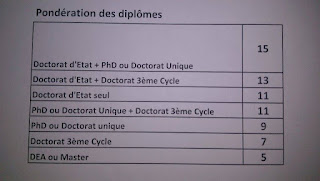
There is the column about professional experience, but it wasn’t weighted as heavily, so it was a bit of a wash between the amount they lost for “redoublements” and what they gained in the experience category. The other part that many questioned, myself included, was the weight of the degree types.

PhDs and Doctorates were most heavily weighted (between 7 and 13 points depending on the type of degree). Masters degrees were weighted at 5 points (side note: if they had multiple Masters degrees, they still only got 5 points…). The interesting part of this was that it didn’t seem to matter what the degree was in. A PhD in French literature was weighted the same as a PhD in American literature (remember this is the English Department of the university).

The Senegalese National Syllabus requires Communicative Language teaching for English, so you would think that those with the most educational background in CLT/TOEFL/TESL would be most valued, but that didn’t seem to be the case. There was a candidate who had 3 Masters degree: One in English from Senegal, a Masters in teaching English from Columbia’s Teachers College, and another in TOEFL from Cambridge. Just looking at degrees, he was awarded the simple 5 points for having a Masters (having 3 doesn’t equate to more points because then it would be equivalent to a PhD…) It also didn’t seem to matter where the degree was done, so a Masters from Columbia’s Teachers College or Cambridge was equivalent to any Masters degree done in Senegal. It was very interesting to follow the process.
I did get to be of some help… One candidate listed that he had a Masters degree from Fulbright. Sounds impressive, right? I had to explain to the committee that Fulbright is a scholarship program, they do not award degrees. His thesis connected to his “Fulbright” awarded degree had the University of Oregon on it, but I could tell something was off. The thesis supervisor was listed with just a name, but no title or university department affiliation to it. Very strange. Needless to say, that candidate did not end up in the top 5.


When they finished with the point system, I thought they would take the top 5 and call interviews, or ask them to do a mini lesson demonstration or something like that, so I was surprised when they chose the person with the most points and called it a day. And that was my crash course in how professors are hired at Universities in Senegal!

Friday

I finally got to teach my first class on Friday! I see each class twice a week, once for American Culture/fluency development and again for Communicative Language Activities. My Friday morning class is with the highest level of students the university has: students who are to be certified to teach high school when they finish here. Many of them have a good amount of teaching experience. The next class was with the students at a lower level who are here to get certification for the middle-school level. There are only 3 men in that class, so they get a lot of fluency practice. These men have numerous years of experience teaching English in elementary schools out in the villages. Their English level is fairly low, so the activities and explanations take more time. They are also much more wary of technology, and I have to remember that they will be working in rural areas that generally have no electricity, so the activities they will be able to do with their students aren’t the same as the other students who will be in the larger cities.
Our first day was just getting to know each other by doing some ice-breakers, and explaining what we were going to accomplish throughout the semester. All the activities we do in our fluency class are also activities that they can use with their students, so usually when we finish one activity, I take the time to explain how I prepared for the activity and we talk about ways to modify it for different levels of students. We had a good time and it was nice to be in front of students again!

That was my first week of “work” and I only actually got to teach on the last day! Oh well, I’ll hopefully get into a rhythm eventually…

Monday, November 14, 2016

Gorée Island


There are places on this earth that, having been witness to unspeakable sadness or horror, hold within them a power that will forever leave a mark on sensitive souls who pass there. Some locations that fall into this category include Auschwitz, the 9/11 memorial in NYC, Montsegur (in the south of France where the Cathars made their last stand), Gettysburg,  and where I found myself visiting on a day off from work, Gorée Island.


The 45-acre island is 1.2 miles off the coast of Senegal and is the most visited site in Senegal. It has been on the UNESCO World Heritage list since 1978 and considered worth preservation by French colonists since 1944. The central location of the island made it extremely valuable for European powers because it connected the North to the South and was easily defendable. Because of that, it was one of the first places in Africa to be settled by European colonists, and a central part of holding power in the area. It changed hands from the original Portuguese, to the Netherlands, then back to the Portuguese, then back to the Dutch, on to British control of it before the French finally took control that lasted until independence in 1960. From the 15th century until the French abolished slavery in 1848, Gorée Island was the center of the West African slave trade. 20 million Africans passed through the slave trading center that was this island. It was the last of the African continent they would touch, and for about 20% of them whose lives would be cut short while on the Atlantic, their final chance to feel solid land beneath their feet.

Fort d'Estrées
We (Brenna, Colleen, Anthony, Alyson, and I) started out our time on Gorée at a museum that traced the history of the island, which cannot be separated from the history of the Trans-Atlantic Slave Trade. The Historical Museum of Senegal is housed inside what used to be Fort d’Estrées, or the Northern Battery, built in 1852.  It has a circular set up that carried us clockwise through history. We learned about the original Portuguese colonists and the changing of hands throughout the centuries. We read about the slave trade and the commerce that drove it. One particular piece of information that stood out to me, for obvious reasons, was how the Spanish would ship horses down to West Africa to trade for slaves. One good horse was worth 20 men...

Gary the Gorée Pelican
After the museum we decided to have lunch while we waited for the House of Slaves to open up again at 2pm. We decided on a place that was right on the water, but in the shade and with a nice breeze. There is always something soothing about hearing waves tumble over rocks and I am glad we chose that particular place. All of us had something traditionally Senegalese: mafé poulet, yassa poulet or yassa poisson with guava or bouye juice (from the baobab tree).  Everything was very good and we lingered over our meals, also indulging in coffee and dessert. We were entertained by a large pelican who decided to join us at the restaurant, hanging out at the door of the kitchen, hoping for something to fall from a passing tray. I’ve never been that close to a pelican, so I don’t know if he was larger than normal, but he was pretty big. We were definitely fascinated by him, naming him Gary the Gorée Pelican for a bit of fun. The whole time I was thinking how jealous my bird-loving cousin Morgan would be that I was this close to one of her favorite birds!


Brenna enjoying the water
We left the restaurant for the House of Slaves, but it was closed for a private tour until 4pm, so we wandered around the island, and especially enjoyed the sand artists. These artists use different colors of sand from all over the regions to create their works of art. They use a special kind of glue and wood to complete each piece. The art is not easily damaged and the only way to ruin it is to soak it in water. The pieces are beautifully done and I am hoping to get some before I leave.

We still had some time, so we went down to the beach and dipped our feet in the water. Brenna was smart enough to remember her bathing suit, so she actually got to go in the beautiful water. It looked amazing and I won’t forget mine next time! We were at the House of Slaves at 4pm so as not to miss it before it closed.
This is the pièce de résistance of the island, an old slave house built in 1776. It was in this house and others like it that slaves awaited their departure on the ships crossing the Atlantic. The ground floor of the home contains holding cells with labels: Hommes, Femmes, Jeunes Femmes, Enfants where the slaves were held awaiting transport, as well as the famous Door of no Return that leads to nowhere but the waters of the Atlantic. This is the place that overwhelms the soul with the tragedy it has seen. Standing in the cell labeled Enfants, I could almost hear the din and feel the despair of crying children unable to comprehend why they were separated from their mothers, fathers, and older siblings. As I stared out of the Door of no Return, I saw the vast morgue that is the Atlantic Ocean and wondered why humanity is capable of inflicting such evil on itself, and will it ever stop?

We were a sober group that left the House of Slaves and decided to walk up the hill to the top viewpoint of the island. As we wound our way up the hill, we passed many artisans selling their work to the cruisers who swarmed the island that day. At the top, I was gazing towards the west when I looked down and realized that I was wearing the jewelry I’d gotten earlier this year in Martinique. It hit me that I had been on both sides of the Trans-Atlantic Slave Trade this year: about 25% of the slaves who left the West Coast of Africa ended up in the Caribbean. It was a sobering, full-circle kind of thing, and I kind of wished there was a Toni Morrison Bench by the Road for contemplation like the one in Fort-de-France.


As we waited for the 5:30pm ferry back to Dakar, I struck up a conversation with a few of the cruisers waiting as well. A couple of snow-birds who spend half the year in Montana and the other half in South Africa, and another couple, originally British, but now living in Michigan. We chatted about traveling and the benefits of seeing, and learning in, different parts of the world, continuing our conversation when we got on the ferry. At this point it was just Colleen, Brenna and myself because Anthony and Alyson had left just after lunch. We were all chatting with each other and the two couples that had sat behind us, discussing the island and its important history. At one point, Colleen and I were chatting and an older British woman sitting in front of us interrupted us to ask Colleen “Do you ever stop talking?” At first, we thought we’d heard her wrong, but she then said “Don’t you ever shut up? You’ve been talking this entire ferry ride!” I was shocked. We were not being particularly loud, and we had been talking with the people around and behind us as well. Colleen answered (more politely than I probably could have) “I’m sorry If us talking is bothering you, maybe you can move to another part of the boat, because this is a public ferry and we paid just as much as you did to be on here.” I was still so shocked that someone would be so rude that I had stopped our conversation, but then willfully started it back up again, just to prove a point. It was a bit of a bummer to end the day in that way.

I definitely want to go back to Gorée Island; it is a beautiful place with a profound history to it that merits multiple visits. Maybe I’ll make sure there aren’t any cruise ships in port next time…

Saturday, November 5, 2016

Saly


Saly

I’d heard that Saly was a nice place and a popular tourist destination, so I headed out there anticipating it would be nice, and boy was I not disappointed!!

Since the rest of the RELO office was already there, I got a ride with a couple of English teachers who were heading out there from Dakar as well. Both teachers in the car were named Abdouleye, so at least I only had one name to learn! Saly is about 60 kilometers from Dakar (that’s about 35 miles), so it wouldn’t normally take more than an hour to get there. The exit off the highway we needed was closed, so it took us a little longer, but we got there. I was surprised when we pulled up outside a 5-Star seaside resort!

The Neptune Hotel has a bungalow style set up, so there were a bunch of round bungalows, each with 4 rooms (2 on the ground floor, 2 upstairs), although I’m sure there were some family-style suites that may have taken up an entire floor, or bungalow for that matter. My suite had a sitting room, bedroom and large bathroom on the ground floor. Because it was during the week of Toussaint vacations in France, there were a ton of French families staying there.

We had arrived around 11am and happened to see Safi as we walked in, so she let us know that we would have a couple of hours to settle into our rooms before the group ate lunch at 1pm. Lunch was a set menu with 2 choices for each course (appetizer, main, dessert) and a choice of drink. I found out that would be the case for every lunch and dinner during the conference.


Lesson planning practice

I was able to see some of the people I had met over the course of the three day orientation we had, including the Access teacher who let us take over her class, Marème, the woman who does the teacher training/evaluation for the Ministry of Education, Ngueye, and the Peace Corps Volunteer, Alex. Those three, along with myself and Safi, were the only women there. The rest of the teachers were men. It’s an interesting difference in that teaching is a predominantly female dominated field in the US, while it is predominantly male in Senegal.

This conference, as I mentioned before, was for Access teachers. As I mentioned in my Orientation blog, the Access program is an after-school program for underprivileged kids (i.e. not the principle’s son or the mayor’s daughter) funded by the US government.

Senegalese Access Students

When an English teacher wants to start an Access class in their school, they go through a pretty long process to get it established, including recruiting 16 students (equally gender balanced) for the 2-year commitment. Not only do the students have to be committed to the program, their parents/guardians also have to be because these students are going to do 360 extra hours of English study over the course of 2 years, including extra lessons twice a week (usually Wednesdays and Saturdays) plus summer camps, enhancement activities such as community service, and some ‘intensive’ sessions of 4+ hours in addition to everything else (in order to get the 360 hours in).


My part of the conference was an hour and 15 minute workshop on Service Learning, Active Citizenship & Leadership training. Since that title was all they gave me as a prompt for my presentation, I wasn’t really sure where to start. I decided to start at the most basic level; with the definition of each term, especially as applied to the Access program. I used the Access handbook as a guide, and after learning more about the program, decided to gear my presentation towards how to integrate all three aspects into an enhancement activity.

I found this article, by Stephanie Harbin, about the value of leadership training for teenagers and integrated that into it as well. In the end, the presentation and discussion went really, really well. The Access teachers all participated and contributed to the discussion, which kept it lively and interesting. It apparently ended up being exactly what the directors of the conference were looking for, which was a lucky, albeit educated, guess on my part.

I was the last presenter on Thursday, and then there were workshops all day on Friday and Saturday morning as well. Because we usually only had a couple of hours in between the end of the day’s conference sessions and dinner, we never actually had time to go into the town of Saly. I’m definitely going to have to come back, since I’ve heard that it’s worth a visit. While there was very little free time during the conference, that time was usually spent with Alex, the PCV, enjoying the pool or the beach. At one point, I was enjoying the pool before dinner and just started laughing…

I couldn’t figure out how on earth it happened that I was sitting in a giant pool at a seaside resort in Saly, Senegal, but I could definitely get used to it (but seriously can’t expect anything like this to happen again, ha ha!). I definitely enjoyed myself, especially getting to know other teachers who are passionate about what they do, and in a spectacular setting.


Monday, October 31, 2016

Settling In


Saturday morning everyone went to their respective locations, with only two Fulbrighters staying in Dakar, myself and Anthony (with his wife Alyson). They hadn’t found housing yet, so they stayed at the hotel while I was driven by an embassy van to my host family’s house in Mermoz.
The yellow place on the left is where I live.
That small structure on top in the back
is my room
When I arrived I met my host mom, Mama Soda, my host dad, Tonton Lamine, and their live-in help, Arame. They actually have another American living with them right now, an exchange student from New Orleans, but she’s out of town with her group until next Saturday. They showed me the house: Walking in the front door, there is a hallway straight ahead, with nothing to the right, and a sitting room with a bedroom to the left. The hallway itself holds a small fridge, some shelves for dining ware, and a low coffee table where smaller meals are eaten (which, being a hallway, makes things a bit cramped).

Continuing down the hallway, it opens up to an outdoor hallway and a staircase to an upper part. Off the outdoor hallway on the left there is another bedroom and a very small kitchen (big enough for one person). On the right, the toilet and a separate shower room (both just big enough for one person to stand). Up the outdoor stairs is my room on the left and the dining terrace on the right. Usually breakfast and lunch are eaten in the hallway and the dinner is outside on the terrace, although I prefer to have my breakfast outside on the terrace because it’s usually pretty nice out there. I would be remiss in providing a good description if I didn’t mention that the house in under the direct path for airplanes landing at Dakar International Airport… very often (maybe once every 10-20 minutes) there is a plane that flies over the house, so low I can practically see how clean the landing gear is! I’m already used to the noise… ;)


My room is about 8 feet by 10 feet with a twin bed, a small desk (think school classroom single desk size), a closet, and a fan. I arrived about 11:30, and we ate lunch around 1:15 before I left again. There was an embassy Oktoberfest/Softball tournament going on that Eran had invited us to, so just after lunch I walked over to Ebbet’s Field, which, luckily for me, is only about a 10 minute walk from the house. Ebbet’s Field is a sports field and playground owned by the US Embassy and for exclusive use of embassy staff & their family (except on special occasions such as this). It’s right on the waterfront (but no beach… that part of the coast is rocks/cliffs), so it has a great view and a nice breeze.
I watched some of the softball games, finally got a hard cider (!!!) and met a lot of the embassy staff and other Americans working in Dakar. I stayed until about 5pm, then headed home. Dinner is usually at 8pm, so I had some time to unpack a little before that time. It felt great after living out of a suitcase for the last 6 weeks to be able to actually unpack!
Ebbet's Field

Sunday morning Tonton helped me get a taxi out to Parcelles Assanies, which is another neighborhood in Dakar quite a distance away. I went out there to check out a church that was planted last year by a missionary that my church in Delaware supports. The pastor here, Brett, and pastor Dan at Skypointe in Wilmington went to school together, so he Pastor Dan put me in touch with Brett before I left Delaware. I wanted to check out their church, so they met me at an easier to find location and took me to the small church they planted. Because the church is composed of Senegalese, Nigerian and Togolese members, the service is done in both English and French. After church, Brett, his wife Elise, and their 4 adorable children took me out to lunch, which was very nice! Then they drove around a bit showing me downtown Dakar (stopping at a great coffee place to grab drinks on the go) before dropping me back in Mermoz. I really enjoyed being at their church, and I wish it was closer to where I lived, but I think the distance is going to make it hard for me to go there on a regular basis. There is an international church that meets within walking distance to where I live, so I’m going to check that out and see how I like it.
I was feeling very run down at that point, almost to the point of being sick, and realized that I had had too many full days in a row without being able to recover from traveling so far and the jetlag that comes with, so I spent the rest of the afternoon/evening resting. Monday I was feeling mostly better after having slept really well, but it was also mostly just resting and preparing my presentation for the conference (presentation subject: Service Learning, Active Citizenship, and Leadership Training).
FASTEF

Tuesday morning I went to the university where I will be teaching to meet the head of the ELT department. My counterpart, Mr. Boye wasn’t there of course because he’s at the conference I would be leaving for the next morning. Dr. Coly simply welcomed me and introduced me to two other English teachers who were there. I won’t start until next week because I’m at the conference for the rest of the week, but technically, classes started this week… and I say technically, because while I was there one instructor went to her first class of the semester, but came back about 20 minutes later because only one student had shown up… “I guess we’ll start next week” she nonchalantly says. Welcome to Africa J

Tomorrow morning I leave for Saly, which is the subject of my next blog post J 

Saturday, October 29, 2016

Orientation


Hello again!

We spent our first three days in Senegal doing an in-country orientation with the RELO (Regional English Language Officer), Eran and his assistant Safi, at the US Embassy. We were 10 people total to partake in this orientation. 8 ETAs and 2 ELFs (English Language Fellows), one of which is actually going to Guinea Bissau, but since the US Government has no representatives there (no embassy or even Peace Corps), he is doing his orientation here with us before he goes down there. Eran (the RELO) met us at the hotel as we were having breakfast and took us all to the embassy in a van. Once we got there, he explained to the guards what we were doing there and we had to check any electronics at the gate, not to get them back until our departure. They even confiscate USB keys! One of the ETAs took a picture of the Embassy sign on the outside of the building as we were walking up, but they made her delete it.
Ambassador Zumwalt welcomes us to Senegal
Day 1 included being welcomed by Ambassador Zumwalt, being given an overview of the Senegalese education system, and having the Access program explained to us. We needed that explanation right away because the afternoon was spent in the field teaching a 2-hour access session at a local high school. The English Access Microscholarship Program is a program that funds 2 years of intensive after-school English classes for underprivileged youth. Students apply for the program and are in it for 2 years, at the end of which they are given a special certificate by the US Embassy. We spent the lunch hours preparing what we were going to do with the 16 students in the program at Yoff High School.
We had fun with them, having them do ice breakers, talking about the different parts of the US we were all from and having them choose where they’d want to go if they could go to the US with some of us. I’m sure it was a bit overwhelming for them because there were 10 of us, plus Eran, Safi, and their teacher, so there were almost as many teachers as students, and it was their first day back from summer holidays! They did fairly well though!
The school is right at the beach, so we stopped there for a few minutes before we headed back to the hotel at the end of the day. On our way back to the hotel we stopped quickly to have our picture taken on/hanging off of a Kar Rapide, which are fairly decrepit, albeit colorfully decorated, little vans with no safety features (such as brakes, for example) that are usually brimming with locals and which can get you from one place to another (the embassy advises us not to use them…) at a very cheap price.

Day 2 was all day at the US Embassy, learning about Senegalese culture from various presenters. For lunch we had a traditional Senegalese dish, which we ate in the traditional style, meaning that we were all seated on the floor around a large dish that we all ate out of together, and with our hands (but not the left hand, sorry lefties!). The rice and fish dish, called thiéboudienne, is the most well-known traditional Senegalese dish. It was very good, but it was hard to get used to eating with your hands without spilling all over the place! The afternoon we had representatives from the teacher training college where I’ll be teaching (FASTEF) and the ministry of education, so they could give us a more in depth understanding of what it takes to become a teacher in Senegal. We finished the day with security and health briefings from embassy staff.

That evening we decided to go fancy for dinner and went to the King Fahd Palace Hotel next to the embassy. It wasn’t as expensive as we were thinking it would be and my maffé (another traditional Senegalese dish) was amazing! We had ended up there because another of the ETAs had a friend who was going there for the live music their night club had going that night, so we went there afterwards to enjoy, especially the drummer who is apparently really well known. We had to be back at the embassy at 9am the next morning, so we didn’t make it too late of a night.

Day 3 was a Friday, so a half day for the Embassy employees (therefore for us as well). The morning was dedicated to learning about public diplomacy at the embassy, so we heard from the Public Affairs Officer (PAO), the Cultural Affairs Officer(CAO), the Information Resources Officer (IRO) and a Peace Corps Volunteer (PCV). They spoke to us about the different US-funded programs and exchanges here in Senegal such as the YALI program (which I worked with in Delaware), Fulbright, and American Spaces. I was very interested in all of this because I will probably be working closely with all of these programs during my time in Dakar. We had lunch at the embassy restaurant and then the van dropped us off at Orange, the cell phone carrier where we would get our phones. It was a bit crowded, so I decided to wait until the next day to get my phone. Those who would be leaving Dakar the next morning had priority.
PAO Reception
The few of us who decided to wait walked the short distance back to the hotel to hang out until the van picked us up again at 4:30 for an evening reception at Bob Post’s house (he’s the PAO). The reception was for us to meet people from the English teaching community in Senegal. My counterpart from FASTEF (the teacher with whom I coordinate), Mr. Boye, was there along with other English teachers and facilitators. We had a nice evening chatting and meeting everyone. Most of the people there I will be working with again, so it was nice to get introductions in an informal setting.

And that was the end of orientation. Tomorrow morning everyone goes to their respective cities and I will move to my host family’s place. Eran (the RELO) let me know that there is a conference starting on Wednesday for Access program teachers (remember the class we taught on day 1, that’s an Access class) in another city and he’d like me to be there to help, so I’m apparently going out of town on Wednesday to Saly, a nice seaside town about an hour south of Dakar. Mr. Boye later told me that I am actually supposed to give a presentation on Thursday and that they’d let me know the topic soon.

… And we’re off!!!

Wednesday, October 26, 2016

Getting there


Hello from Senegal!

My trip out here was a very long one. Before leaving I had calculated that, from door to door, I would be traveling about 28 hours, and that’s if everything was exactly on time. This was my original itinerary:

9:30 departure from Alimar to catch my 11:15am bus from Bakersfield to Los Angeles.

2pm shuttle from  Greyhound Station to LAX

6:35pm flight from LAX to Paris (arrive in Paris around 2pm local time)

4pm flight from Paris to Dakar (arrive in Dakar at 8pm local time)

Embassy van transport from Dakar Airport to our hotel (there were 7 of us flying together).

Most of this actually went as planned, which was nice. The bus ride was made more pleasant by having made friends with a nice older woman, Marsha, who sat across the aisle from me. She had asked when she got on the bus if anyone else was going to LAX and would like to share a taxi with her. I told her I had booked a shuttle and I could call to see if they had room for one more. They did, which she appreciated because it was a lot cheaper than a taxi. That also meant I had someone to wait with at the Greyhound station in LA. We had about 40 minutes, so we took turns watching each other’s things so we could use the bathroom and order something for lunch. The ride to the airport was also nice because there was a couple on there heading to Europe for the first time. They were going to Paris and Rome to celebrate their 25th wedding anniversary, so I was able to give them some pointers for both of those places. 


Oops... ;)
LAX went fairly well, although I had made the mistake of accidentally leaving a wine bottle opener in my carry on. I need to remember to completely empty a bag before I pack it for a flight! But at least I had a nice conversation with the guy searching the bag. I felt bad because it took him forever to find it and I couldn’t help him because I didn’t even remember it being in there! He was a French guy from Pau, where one of the other students with me at UD was from, so we chatted in French until he found it… Other than that, it went smoothly. The woman at the check-in counter didn’t quite believe that I didn’t need a VISA, but the letter the US Embassy sent me for that purpose seemed to work and they let me on. I had some time before my flight, so I went in search of what I thought would probably be my last hard cider for a while. I stopped at pretty much every place that served alcohol, with no luck. What kind of American West Coast bar and/or restaurant doesn’t carry at least one cider!?!? I finally gave up, ordered a glass of wine and some sushi, which I ate while making some final phone calls before calling and canceling my Verizon number. Our flight boarded and took off on time, so no worries there. I was on AirFrance, which has pretty much the best little video for the security information.

The meals weren’t bad as airplane food goes, and AirFrance offers champagne, wine or liquors with their food service, which I noticed many people taking advantage of at dinner. I have never been able to sleep on flights, so I spent the 11 hour flight watching movies, playing Sudoku and pretending to try to sleep.

The layover in Paris was pretty short, only about 2 hours, and some of the other ETAs I had met were there as well, waiting for our flight to Dakar. Our flight boarded on time, but then we sat on the runway for an extra hour due to a medical emergency on board. They called for a doctor on board, and then the passenger, with his family, had to be taken off the plane. They also took the time to unload their luggage, so we left about an hour late. We were able to make up about half of that time and arrived in Dakar only 25 minutes after our scheduled time.


Customs were a breeze, but getting the bags, not so much. Unfortunately, one of my suitcases didn’t make it to Dakar with me, which meant that we all waited until the very last bag was unloaded and the carousel was turned off. I was grateful that the other ETAs waited for me as I reported it to the AirFrance office.
Turns out that my bag didn’t get back on the flight after they emptied the luggage for the medical emergency, so they had it going on the next day’s flight. They said they’d deliver it to the hotel when it came in, so off we went to find our ride. We had to go through security to get OUT of the airport (still don’t understand that…) and our driver was waiting right there for us. We arrived at the hotel around 10:30pm local time (which is 3:30pm California time/6:30pm Delaware time), making my actual travel time almost exactly 30 hours. All in all, everything went fairly well, but I was definitely looking forward to a shower and bed!

Next blog: Orientation at the US Embassy!

Monday, October 24, 2016

Pre-Departure


Hello to everyone coming along with me to Senegal! Here is my first blog with all the basic information:

 Where am I going?

Senegal is in West Africa, which is also part of Sub-Saharan Africa because it is below the Sahara Desert (as compared to North Africa). Dakar is the capital and largest city, which is on the coast and contains within it the western most point of the African continent. I will be staying with a host family in Mermoz, which is the name of a neighborhood in Dakar.


Why am I going?

I am going to Senegal on a Fulbright Scholarship. This program, named after the US Senator who proposed creating an exchange program to promote international goodwill in 1946, awards around 2,800 grants for Americans to go abroad each year. Those can be teaching or research grants that can be in more than 140 countries all over the world. They also bring students, teachers and researchers to the US, usually about 5,200 per year, for a total of 8,000 exchange grants per year. There are three different types of grants; the ‘student-scholar’ for those who have just finished their undergraduate degree, or graduate students doing research, the ‘scholars’ who are University faculty members with a PhD doing advanced research or guest lecturing at universities, and English Teaching Assistants (ETAs) who teach English. Many of the ETAs are just finishing their undergraduate career and are doing this kind of as a gap year, and a few are like myself in having just finished a graduate degree in the field of language teaching. Though most of the other Fulbright scholarships are for a shorter amount of time (say, 3 months or so) the ETA contract is for 9-months.

How did I get here?


The application process to get a Fulbright is pretty long. I started my application in early August of 2015, but the University of Delaware usually requires starting in July if you want to have an advisor to help you with your essays. Because I was just after their deadline, they allowed me to have one anyway, which was an invaluable asset as I wrote the two, one-page essays (for ETAs… the application is a bit different for scholars who have to propose a research project). They have applicants write a Personal Statement and a Statement of Grant Purpose. The advisor helps you to make sure you are using each word wisely, as you only have one-page, single-spaced, to convey why you should receive a grant to the specific country you are applying for. The UD deadline for the completed application, including three recommendations and a language evaluation, was September 15th. A huge shout out goes to those who helped me with recommendations, language evaluations and essay writing: Colin, Donna, Dr. Steinberger, Katharine Kerrane, and, of course, Anna, who probably put almost as many hours into my application as I did!
Couldn't have done it without Anna! <3

 After that was done, the Fulbright committee at UD reviews the application and conducts an interview. During the interview, they asked for more information about why I chose Senegal and not another country, and they gave me suggestions for final touches on my application. They also use the interview to decide whether or not to recommend me to the Fulbright Committee once I turned my final application in on October 15th. Then the waiting game starts. I didn’t hear anything else until January when I was told that I was a semi-finalist. Whether or not I’d actually been granted the Fulbright I didn’t know until around the 15th of April. After that, we had orientation at a hotel in Washington DC in mid –June where we were with all the other Fulbrighters (of all kinds) going to Sub-Saharan Africa. They hadn’t confirmed our assignments yet, so we had to wait until July to know where in Senegal we were actually going to be. There are 8 of us ETAs going to Senegal, so 2 in each major city (Dakar, Thies, Saint Louis, and Ziganchor).

What am I doing there?

Because I have a graduate degree in the field, I will actually be teaching at the local teachers college (FASTEF), helping to train those students who want to become English teachers here in Senegal. I will also be working with the RELO (Regional English Language Officer) of the US Embassy to help promote English teaching in the region. What all this actually entails, I’ll find out when I get there!

This blog is for everyone who said they’d like to keep in touch, keep up with what I’m doing, follow my adventures, and live vicariously through me. I hope you’ll all join me on my newest adventure!


A journey can become a sacred thing:
make sure, before you go,
to take the time
to bless your going forth,
to free your heart of ballast
so that the compass of your soul
might direct you toward
the territories of spirit
where you will discover
more of your hidden life,
and the urgencies
that deserve to claim you.


May you travel
in an awakened way,
gathered wisely
into your inner ground;
that you may not waste
the invitations which
wait along the way
to transform you.
May you travel safely,
arrive refreshed,
and live your time away
to its fullest;
return home more enriched,
and free to balance
the gift of days
which call you.


An excerpt from "For the Traveler" ~ John O'Donohue
From: To Bless the Space Between Us